Comments on Oshins' Research
- Natural Scientists
- Louis H. Kauffman
- H. Pierre Noyes
- Lawrence C. Biedenharn
- Yuri F. Orlov
- Social Scientists
- Ernest R. Hilgard
- Roger N. Shepard
- Rue L. Cromwell
- John H. Weakland
- Jerome S. Bruner
- Policymakers
- Max M. Kampelman
- Human Rights Activists
- Sidney Hook
- San Francisco Chronicle
- Joel Shurkin
- Vladimir Lefebvre
- Yuri F. Orlov
- Yuri Yarim-Agaev
Natural Scientists
Louis H. Kauffman:
... [As] a capsule description of his work and its significance for mathematics, physics and psychology ... Oshins has been a pioneer in the interpretation of quantum theory and quantum logic both for physics and for psychology. He has, in the course of his career, clarified the wave logic of Yuri Orlov, made very creative suggestions about the possibility that the human brain processes superpositions in a way that is mathematically analogous to the evolution of a state in quantum mechanics, and made very remarkable connections among standard logic, the logic of distinctions of G. Spencer-Brown and the insights and techniques of quantum logic. These topics are highly significant ...
Oshins has suggested that superposition and spinor properties of brain action may be observable through the use of SQUIDs, CAT scans and magnetic resonance devices. These experiments should be performed. ...[H]e and I found a very beautiful representation of the quaternions that is performed by hand and arm movements.
... These ideas are refreshing and open a window to new ways of asking such questions, irrespective of these outcomes.
On the side of logic and the logic of distinctions, Oshins brings an entire dimension that is ignored by orthodox logicians and mathematicians. Both Oshins and I have independently explored the phenomena of self-reference as conceived of by G. Spencer-Brown.
... It was Oshins who first laid-bare the lattice theoretic similarities and differences between these approaches. Intriguingly, Oshins' line of attack leads to a nondistributive and complemented lattice --- precisely the opposite result to our extension of the same original work of Spencer-Brown!
... Oshins has been persistent and insistent on the relevance of the quantum logical point of view .... He has shown that the logically correct formulation of the "formula of second-order change" ("not a but also not not-a ") as presented in MRI brief therapy is as a violation of the distributive law.
Oshins has proposed an ingenious interpretation of this violation in terms of an explicit Principle of Metalogical Ambiguity for competing, complementary contexts. He has used this approach to formally harmonize what was previously considered irreconcilable points of view regarding schizophrenia as a logical phenomenon.
... Oshins was one of the few people who stood up for [Yuri] Orlov's work when Orlov was in prison in the former Soviet Union, and Oshins was instrumental in helping Orlov gain his freedom.
In summary, Eddie Oshins is a highly creative and courageous researcher, one of the most honest scientists I know. I recommend him to you with all my heart.
--- May 10, 2001 Open statement on behalf of Oshins' Quantum Psychology.
Professor Louis H. Kauffman, Editor in Chief, Journal of Knot Theory and Its Ramifications; Editor, Knot Theory and Everything, World Scientific.
H. Pierre Noyes:
...
"I know of no one who has come closer to opening up a new field for scientific exploration than Mr. Oshins. I have known him for over a decade, and saw sufficient promise in his earlier efforts to sponsor him as a visitor at the Stanford Linear Accelerator Center for five years (our maximum term), -- even though this stretches the terms of our contract. ... if you decide to support Mr. Oshins, you will have the rare opportunity of supporting an acknowledged pioneer before there is general recognition of the field. ... Mr. Oshins is the best candidate I can think of for your support, and I recommend him without reservation."
--- January 31, 1985 letter to the John Simon Guggenheim Foundation on behalf of Eddie Oshins.
Professor H. Pierre Noyes sponsored Oshins' research in the Theoretical Physics Division, Stanford Linear Accelerator Center, 1977-1982.
Lawrence C. Biedenharn:
"... now to your remark on the 'psycho-turn' hypothesis. This is a most remarkable and interesting concept ... The experimental data you mention ("population vector" and the like) is quite new to me. ... The fact that you have testable hypotheses indicates to me the subject is well worth exploring further. Certainly 'addition' is far simpler to achieve than 'multiplication', but the non-commutativity (for rotations) must be built into the system, regardless of how it is encoded. ... [I] can only ask you to let me know how I can help. Above all, don't give up!"
--- August 28, 1992 letter
Lawrence C. Biedenharn Editor of Journal of Mathematical Physics, 1985-1992.
Yuri F. Orlov:
"First of all about the scientific cooperation/collaboration. I was very impressed that independently and before me you have started to develop the ideas that are close to mine. It is true that you are applying these ideas to the subject with which I am not very familiar. ... a theory of dialogue should be constructed . In a dialogue ... participants speak 'different languages.' Their statements do not commute with each other [have intrinsic incompatibilities], even if they use the same words. Theory should develop methods to analyze ... [these] ... mutual misunderstandings and to over come them. ... You have thought a lot about these things and will probably agree with me: it is not possible that such a deep mathematical apparatus had only very narrow sphere of application. But so far we have been treading water, both of us! Good-bye, Your friend, Yu. Orlov"
--- September 1984 smuggled letter to Eddie Oshins from Yuri Orlov from internal exile in Kobyia, Siberia.
"I am very familiar with the work of Eddie Oshins in what I believe to be a new and promising field of quantum psychology. ... The importance of this field includes its potential for creating new and fundamental insights into neurological functioning and for the understanding and treatment of neurological and psychological disease. His ideas contain experimental proposals which could provide a firm empirical basis for this field. However, because of the newness of this work, Eddie has had great difficulty in developing a support base. ... I am bringing his work to your attention because Eddie was one of the first people to recognize my own related research. He actively represented it and played a major role in getting it published in the United States. ... I strongly urge that your foundation find a way to fund him and his work."
--- January 28, 1987 Appeal by Yuri Orlov for support for Oshins' Quantum Psychology Project®
Yuri Orlov is a Senior Scientist at the Floyd R. Newman Laboratory of Nuclear Studies at the Cornell University Department of Physics, and, currently, Honorary Chair International Helsinki Federation for Human Rights.
Social Scientists
Ernest R. Hilgard:
"Oshins' work is serious and insightful. ... Both ['the intrapsychic approach' and 'double-bind theory'] ... have their limitations and Oshins proposed a third one his quantum psychology that serves as a synthesis to deal with the problems that the other approaches tried to solve but corrects some of their difficulties ... through the quantum method of dealing with ambiguity as a type of equivocation in which the distributive law of set theory and thus of classical logic is violated Oshins proposes replacing it with a quantum principle of metalogical ambiguity ... [in] a dinner conversation I had with Niels Bohr ... he assured me that complementarity was a principle not only for physics but was generally applicable and in another generation would be taught to school children ... Oshins has alerted us to some possibilities. ... He makes a case for the formal power of his model as in the development of operational thinking in children as noted by Piaget and going beyond it.
... A further point is his emphasis on the role of negation ... that unconscious processes (primary processes) lack negation. Negation Oshins says is necessary for conscious processes, for mature judgment and to form boundaries between the self and others ... Oshins goes on to use Finkelstein's theorem1 ... to code a negative in the information content If the capacity to form negatives proves to determine the capacity to have consciousness, an existing technology might be able to demonstrate this. ... This is a bold suggestion and something on which we cannot pass judgment until it is tested. ... I can find much in it that intrigues me as my summarization suggests. ...
1This is best understood as a 'conjecture' not a theorem.
--- 'Reflections on the Future of Scientific Psychology,' Paper presented to panel on The Future of Scientific Psychology. 1989 AAAS Annual Meeting, San Francisco, CA. (Discusses Oshins' 1989 AAAS paper)
'I have known him [Oshins] for many years, see him frequently, and am familiar with his published scientific articles. ... in the mid-1970s he became convinced that he had a formal way to reconcile arguments in the psychological literature concerning the nature of schizophrenia. His model, which in the early 1980s he coined 'quantum psychology,' attempted to harmonize the Von Domarus principle of 'identification by predicates' with the Bateson, et al. 'double-bind theory.'
The endeavor by Oshins contrasts notably with other attempts to relate quantum physics with psychology. These have usually been either purely philosophical or often loose, incorrect, and even fraudulent associations. In contrast, Oshins believes that he may have found physical consequences to his psychological work. His approach is critical formal and empirical. Although this work still awaits experimental confirmation, I find his insights informed and deep, and his reasoning compelling.
...
--- November 24, 1993 open statement.
Professor Hilgard, member NAS, is Emeritus Professor of Psychology (Cognitive Psychology and History of Psychology), Stanford University. He was a former President, American Psychological Association.
Roger N. Shepard:
"Having read a number of Eddie Oshins' papers and memoranda over the past few years, I am quite persuaded that it was Eddie who first brought Zadeh's 'fuzzy sets,' Spencer Brown's 'laws of form,' and Von Neumann & Birkhoffs' quantum logic' together with the 'double-bind mechanism' of Bateson, Jackson, Haley, and Weakland, and the principles of Von Domarus and of Arieti, in order to provide a unified formal scheme for the characterization of schizophrenic thought. ... Further it is Oshins, not Orlov, who is insisting the 'the experience of doubt is of a quantum mechanical nature' (cf., Orlov, Annals of the NY Acad. Sci., 1981, 373, p. 88)'"
--- January 15, 1983, letter.
"One of the most extreme manifestations of the difficulty … of taking simultaneous account of two or more distinct features of an analyzable object or situation may be that characterized by Von Domarus’ principle according to which the schizophrenic is said to accept identity of subject on the basis merely of identity of a single predicate, feature, or part. Thus, from the premises "The Virgin Mary was a virgin" and "I am a virgin," in a perversion of the syllogism (Mode of Barbara), the schizophrenic may conclude "I am the Virgin Mary." (Arieti, 1948, 1967; Oshins & McGoveran, 1980; Von Domarus, 1944.)"
--- (book in preparation, circa 1983). Internal representation: studies of perception, imagery, & cognition, Chapter 6, "Representation of unitary versus analyzable stimuli, and of elementary properties versus natural kinds," pp. 6-12 - 6-13.
Shepard continues (pp. 6-20 - 6-25) by describing the "Implications of the Unitary-Analyzable Distinction for the Metric of Perceptual Space" by providing "Nine empirical criteria for determining analyzability," such that "the distinction between unitary and analyzable stimuli ... for human cognitive processes appears to be beyond doubt" (Shepard 6-20 - 6-25).
Professor Shepard, member of NAS, is the Ray Lyman Wilbur Emeritus Professor of Social Sciences (Cognitive Psychology) at Stanford and the William James Fellow of the American Psychological Society. He is recipient of 1995 National Medal of Science, and 1976 APA Award for Distinguished Scientific Contributions to Psychology.
Rue L. Cromwell:
"... Eddie Oshins ... is a highly creative thinker and with bright ideas. His application of quantum logic to the understanding of thought disorder in schizophrenia is an ingenious one. He is quite aware of much of the research on thought disorder and double bind communication, such as that by Bateson, Lidz, and others. In many respects the endeavor by Oshins goes well beyond anything which is current in clinical psychiatry. Usually the attempt is to tag surface clinical observations to treatment, prognosis, and past social etiology. By contrast, Oshins has his primary focus upon understanding the structure by which information is organized in a system, human or not, disturbed or not. In this respect his work shows promise of having a unique impact. ... I ... view his ideas as stimulating and provocative rather than bizarre and unfeasible. ... I have no doubt that some would be threatened and rejecting of his ideas, not to mention his background and qualifications for doing such work. But that is true when anyone offers a dramatically new approach to a problem. ...'
--- July 13, 1981 letter.
'Propositional thinking occurs when a person considers new information as a way to reformulate existing conceptual structure. ... uncertainty (and subsequent inquiry) becomes a continuing, dynamic process for the predominantly propositional thinker. Especially for us clinicians, who have to make practical decisions, this dynamic process and its uncertainty are irksome compared with a comfortable static structure in our knowledge. Only the scientist in us takes delight. In recent decades, physics and astronomy have illustrated how scientists have availed themselves of propositional thinking (and then new data) rather than subordinating or preempting new information. It is therefore not surprising that quantum theoreticians from physics (Oshins & McGoveran, 1980; Orlov, 1982) have introduced models of doubt states in human thinking and consciousness.'
--- (1983). 'Preemptive Thinking and Schizophrenia Research.' In W. D. Spaulding (ed.) Nebraska Symposium on Motivation 1982-3. University of Nebraska Press
Professor Cromwell, the M. Erik Wright Distinguished Professor Emeritus of Clinical Psychology, University of Kansas.
John H. Weakland:
'Congratulation on your award as Alternative Natural Philosopher of the year at the recent regional meeting of the Alternative Natural Philosophy Association at Stanford for your original and creative research linking quantum physics to psychology. ... Your efforts remind me somewhat of the early days at the Mental Research Institute. Trying to fund truly pioneering work is very difficult frustrating, and can be quite hard on one. As you know our own persistence in advancing our international approach eventually paid off and led to the evolution of family therapy in the 1950s, in addition to other foundational work in therapy some of which, such as our brief therapy approach, eventually attracted your own attention and talents. ... I believe that the Mental Research Institute ... might be an ideal place for you to continue certain of your ongoing activities appropriate to our mandate. ... Keep up the good work and hang tough.'
Mr. Weakland (Clinical Anthropology) was a co-originator of the "double bind theory of schizophrenia," and Co-Director, Brief Therapy Center, Mental Research Institute.
Jerome S. Bruner:
"This was perfectly fascinating ... very interesting. I can see why you're excited about the application of these in domains that really do ... let me put it this way: It is plain that they don't fit the classical case. ... There are suggestions that it may fit the quantal case. And now comes the question of how you can instantiate these ... unambiguously enough to make some sort of a more reasoned case for the positive instance. ... Now you have to ... demonstrate the differences ... Great good luck on this. I mean because if you're even partly right about the applicability of this very, very powerful formalism on the mind for the description of certain kinds of experience, you have made something very important of your efforts."
--- May 21, 1987, tape transcription while he was 1987 Hilgard Visiting Professor at Stanford.
Professor Bruner, member NAS, is the George Herbert Mead University Professor (Cognitive and Developmental Psychology) at the New School for Social Research. He has been a recipient of the APA Award for Distinguished Scientific Contributions to Psychology.
Policymakers
Max M. Kampelman:
"I have seen your letter in the current publication of Freedom House on Orlov. I am very pleased that you are continuing to remind people about him. He must not be forgotten."
--- July 21, 1986 letter from Ambassador Kampelman to Eddie Oshins. This was written in response to Oshins' solicited opinion:
"... Even if we are incorrect regarding our current convictions about experiments, considering the tension and mistrust that exists in our turbulent world, might it not be a meritorious, symbolic cooperation for a scientist from the East and a scientist from the West to attempt such an endeavor? At worst, we will err regarding our ideas ... at best, might we all not benefit? I hope that Orlov and I will have an opportunity to try."
--- Eddie Oshins, "The Plight of Orlov," Freedom at issue, no. 91, July-August, 1986, in which Oshins reviewed the humanitarian and scientific basis for the case of Yuri Orlov and challenged the world to allow Orlov and himself to collaborate on their mutual scientific work on wave logic and quantum psychology.
"Your letter of September 11 was forwarded to me in Geneva. It arrived today as the news programs reported on Mr. Daniloff's release. I do not know the details of the negotiations or their results, but let us hope that Professor Orlov was prominent in the minds of those who were negotiating on behalf of our government.
"My best wishes, to you."
--- September 29 letter to Eddie Oshins. The letter refers to Oshins' September 11, 1986 proposal, "... in regard to the recent detainment of Daniloff and the Soviet effort to join this situation with the Gennady Zakharov incident. I believe that this occurrence might provide a strategic opportunity for the United States to add Professor Orlov to a possible exchange. ..." This letter was also circulated around Stanford University and elsewhere. It is the earliest known proposal for the Daniloff/Zakharov/Orlov trade that subsequently took place in the beginning of October 1986.
"Thank you very much for your thoughtfulness in sending me your comments prepared at Mr. Finn's request. I look forward to the publication of that paper which I found to be of keen interest."
--- February 22, 1988 letter to Eddie Oshins. The letter refers to Oshins' 1988 invited opinion on "Chernobyl: past & future: From MAD to GLAD", Freedom at issue, no. 102, May-June, 1988).
AmbassadorMax M. Kampelman, Head of Delegation, Negotiations on Nuclear and Space Arms, United States Department of State.
Sample Evaluations of Oshins' contributions to Orlov's freedom
Sidney Hook:
"I have just received your material on Yuri Orlov. You are doing a noble work not only on his behalf but on behalf of all of us. ... I regard your research as very much worthwhile. ... I shall be glad to write in support."
--- May 3, 1982 letter to Eddie Oshins.
Professor Sidney Hook was Emeritus Professor of Philosophy and Senior Fellow, Hoover Institute, Stanford University
San Francisco Chronicle:
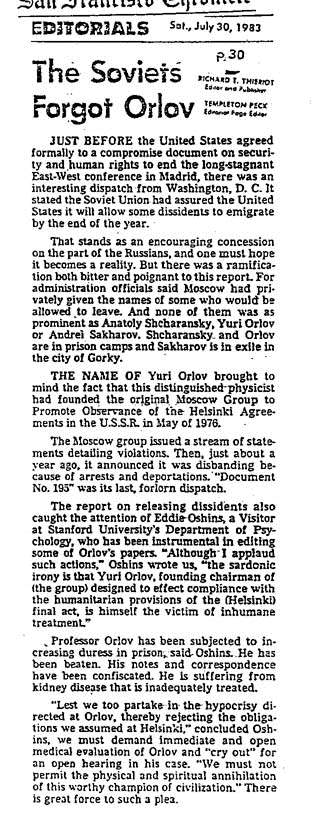
"The report on releasing dissidents also caught the attention of Eddie Oshins, a Visitor at Stanford University's Department of Psychology, who has been instrumental in editing some of Orlov's papers. 'Although I applaud such actions,' Oshins wrote us, 'the sardonic irony is that Yuri Orlov, founding chairman of (the group) designed to effect compliance with the humanitarian provisions of the (Helsinki) final act, is himself the victim of inhumane treatment.'
"Professor Orlov has been subjected to increasing duress in prison, said Oshins. He has been beaten. His notes and correspondences have been confiscated. He is suffering from kidney disease that is inadequately treated.
"'Lest we too partake in the hypocrisy directed at Orlov, thereby rejecting the obligations we assumed at Helsinki,' concluded Oshins, we must demand immediate and open medical evaluation of Orlov and 'cry out' for an open hearing in his case. 'We must not permit the physical and spiritual annihilation of this worthy champion of civilization.' There is great force to such a plea."
---"The Soviets Forgot Orlov," San Francisco Chronicle Editorial, Saturday, July 30, 1983, p. 30.
Joel Shurkin:
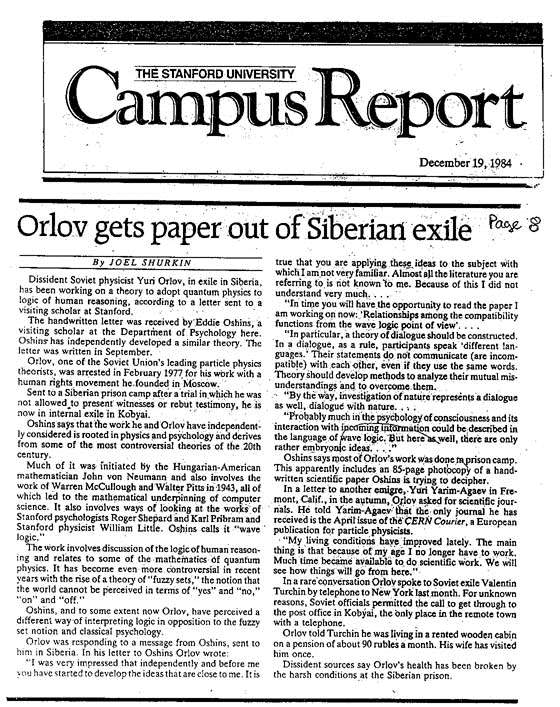
"Dissident Soviet physicist Yuri Orlov, in exile in Siberia, has been working on a theory to adopt quantum physics to logic of human reasoning, according to a letter sent to a visiting scholar at Stanford.
"The handwritten letter was received by Eddie Oshins, a visiting scholar at the Department of Psychology here. Oshins has independently developed a similar theory. The letter was written in September. ...
"Oshins says that the work he and Orlov have independently considered is rooted in physics and psychology and derives from some of the most controversial theories of the 20th century.
"Much of it was initiated by the Hungarian-American mathematician John von Neumann and also involves the work of Warren McCullough and Walter Pitts in 1943, all of which led to the mathematical underpinning of computer science. It also involves ways of looking at the works of Stanford psychologists Roger N. Shepard and Karl Pribram and Stanford physicist William Little. ... [Orlov] calls it 'wave logic.'
"The work involves discussion of the logic of human reasoning and relates to some of the mathematics of quantum physics. It has become even more controversial in recent years with the rise of a theory of 'fuzzy sets,' the notion that the world cannot be perceived in terms of 'yes' and 'no,' 'on' and 'off.'
"Oshins, and to some extent now Orlov, have perceived a different way of interpreting logic in opposition to the fuzzy set notion and classical psychology."
--- Joel Shurkin (December 19, 1984). "Orlov gets paper out of Siberian exile," The Stanford University Campus Report, p. 8. A clarification and elaboration is found in Eddie Oshins, "Terms in Orlov story require clarification," The Stanford University Campus Report, January 9, 1985, letters to the editor, p. 10.
Joel Shurkin is a Pulitzer Prize winning journalist.
Vladimir Lefebvre:
“It would be unlikely that a significant number of them [“The Western scientific community”] would have heard of Orlov’s struggle, much less of his scientific work, if it had not been brought to their attention. Here Orlov was very lucky. One American has devoted his whole life to Orlov cause without any financial recompense: he fought for Orlov liberation and transformed his notes into publishable papers. This man’s name is Eddie Oshins ... It seems symbolic that the hand extended by Orlov from a Siberian labor camp met not the hand of a famous Western scientist but the hand of a man whom some people view as an outsider. But Oshins is not an outsider, he is a genuine hero in this story.”
--- March 28, 1987 Letter to MacArthur Foundation
Vladimir Lefebvre (Dissident psychologist) is creator of the "Algebra of Conscience"
Yuri Orlov:
I will always be grateful for the time and energy you have devoted to me. ... Whenever I discuss my psychological ideas, I always credit your work and help. ... I will always feel maximum gratitude to you ... and always mention your name when I discuss my ideas."
--- April 7, 1987 Letter to Eddie Oshins
Yuri Orlov (Dissident physicist), Founding Chairman, first Moscow Helsinki Watch Group, was in the Soviet Gulag from 1977 to 1986.
Professor Orlov is currently a Senior Scientist at the Floyd R. Newman Laboratory of Nuclear Studies of Cornell University's Department of Physics, and Honorary Chair International Helsinki Federation for Human Rights.
Yuri Yarim-Agaev:
"Mr. Edward Oshins, whom I met soon after moving to California in 1981, was in this sense a rare exception among American scientists. He was ready to take a strong position in defending his persecuted colleague, Dr. Orlov, whether or not it would please the Soviet establishment and his peers in the U.S.. Eddie Oshins and Yuri Orlov shared two important things --- humanitarian ideals and their interest in a new and yet very unpopulated area of science, quantum logic. Possibly this unique combination provided Eddie with the strength necessary to sustain a long and effective campaign on behalf of Yuri Orlov. Without organizational and financial support, Eddie succeeded in doing more than any other organizations or institutions.
"In campaigning for Dr. Orlov's freedom, Eddie saw his most important task in publicizing Orlov's scientific achievements. Orlov himself considered his scientific work vital and managed to continue it in the unbearable conditions of labor camps and internal exile. While in prison he carried out several new works and smuggled them out to the Western scientific audience, these manuscripts had to be translated and published. This task would require both deep professional knowledge and commitment. There was only one person who could do that, and it was Eddie Oshins. The publishing of Orlov's papers was crucial for his survival. It helped to reinforce the campaign on his behalf in the scientific and human rights community and to make his release one of the U.S. government's priorities. When the opportunity occurred, the government succeeded in bringing Orlov to the United States before the end of his internal exile.
"Several years earlier, when Orlov was transferred from labor camp to internal exile, we established communications with him through his wife and friends. In my first letter to Orlov, I recommended Eddie Oshins to him and described Eddie's actions on Orlov's behalf. Orlov was very impressed. Although it was difficult for him to communicate any information to the West, he allocated large part of his efforts to Eddie, thanking him for his help and discussing with him common scientific interests and ways to present his scientific results. These communications helped to bring to the U.S. new scientific papers by Dr. Orlov but did not help to obtain financial support for the work that Eddie was being asked to do for Orlov --- a considerable burden that Eddie had to accept by himself.
"In his first days in the U.S., Orlov was perhaps the most popular person in the country and was even invited to meet the President of the United States. Most senators and congressmen sought to meet with him, and many were denied because of his overbooked schedule. Yet he reserved much of his time for meetings with Eddie, who came from California to New York to greet him. Orlov thanked Eddie for his important assistance. He also discussed with him common scientific interests and plans for future cooperation.
"Dr. Orlov also realized that Eddie's work on his behalf did not score points for Eddie with the American scientific establishments. Even before Eddie's campaign on Orlov's behalf, the position of the young scientist in a yet very innovative area was not well established. And his campaign hardly helped him in this respect. Yet, Eddie did all he could to use his own research in order to argue on behalf of Orlov's work and to draw attention to Orlov's plight. Dr. Orlov assured Eddie that he would use his influence to make sure that Eddie's scientific career would not suffer any longer because of what Eddie did for him, and secure proper support for Eddie's research.
--- August 31, 1995 Statement on behalf of Eddie Oshins
Yuri Yarim-Agaev, one of the 16 members of the former Public Group to Promote Observance of the Helsinki Accords in the USSR (aka, first Moscow Helsinki Watch Group) was forced to expatriate to the U.S. in July 1980. He arranged for the 1984 Oshins/Orlov smuggled scientific correspondence.